
Which coffee grind matches your brewer?
Start with your equipment: fine for espresso, medium for a classic drip machine and coarse for French press or cafetière. For a fully automatic machine, order whole beans. These are starting points; your brewer's recipe and your taste decide the final setting.
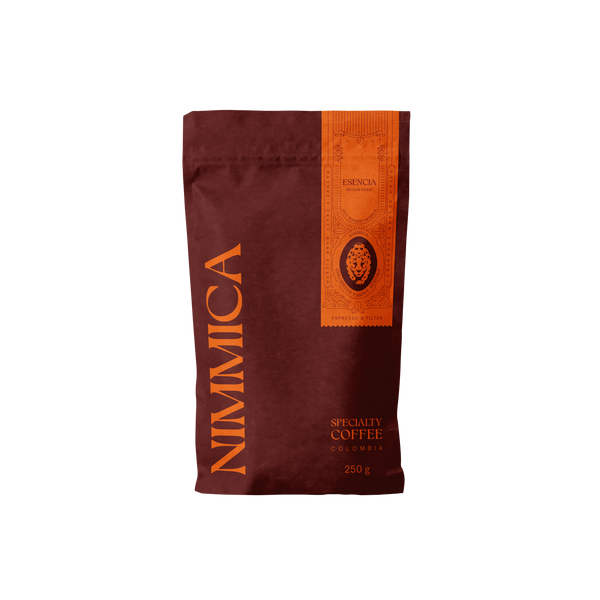
You can use the same coffee in more than one way. Nimmica Esencia, our Colombian Arabica roasted in Belgium, brings chocolate, walnut and dried-fruit notes to your daily cup. Choose the grind for the way you brew it.
French press grind: is it the same as filter grind?
No. Start coarser for French press than for a classic drip filter. The coffee steeps in the water, then a metal mesh separates most of the grounds. A little sediment is normal. Very fine grounds can leave more sediment and make plunging harder.
Choose French press / cafetière when ordering ground coffee. Espresso grind is much finer and is not our recommended starting point for this brewer. If you already have standard filter-ground coffee, you can try it, but expect a different texture; change to a coarser grind for your next comparison.
A simple French press starting routine
- Use coarse-ground coffee and the coffee-to-water quantity recommended for your press.
- Add hot water and stir gently with a suitable spoon. Follow your press's filling limit.
- Start with a four-minute steep, then lower the plunger slowly. Do not force it if it resists.
- Pour your coffee and adjust one variable at a time on your next brew.
Bodum's French press instructions use coarse grounds and a four-minute brew. Different recipes can work too; treat this as a clear first attempt rather than one compulsory method.
Espresso: fine grind, small adjustments
For a manual espresso machine, choose whole beans if you have a grinder that can grind for espresso. Without a grinder, choose espresso grind. A fixed pre-ground setting cannot fit every basket and machine perfectly, so contact us with your model if you are unsure.
If coffee rushes through and tastes weak, a finer grind may help. If it barely flows, try coarser. Keep the dose and preparation consistent while changing the grind. Your machine's instructions come first.
Filter coffee: start with the recipe for your brewer
A classic drip machine usually starts with a medium grind. Pour-over recipes vary: Hario's V60 guide uses medium-fine coffee. Its example is 15 g coffee for 250 ml water, a useful small brew to adjust to taste. See Hario's V60 recipe.
AeroPress is not simply interchangeable with drip coffee. AeroPress recommends medium-fine as its starting point, between drip and espresso. Follow the recipe for your brewer and tell us which model you use if you need help ordering ground coffee. Read AeroPress's grind guide.
Fully automatic machine: select whole beans
A bean-to-cup machine grinds each portion itself. Choose whole beans and put them in the bean hopper. For practical taste adjustments, read our guide to coffee beans for automatic machines.
Whole beans or ground coffee: what should you order?
- You own a suitable grinder: choose whole beans so you can adjust the grind yourself.
- You do not own a grinder: choose the grind matching your brewer on the product page.
- You brew with several different devices: whole beans give you flexibility; otherwise keep separately ground coffee for each method.
Choose your coffee, then your grind
For a rounded everyday starting point, order Esencia. Select 250 g or 500 g, the right grind and the number of bags, then check your basket before checkout. If you want to compare flavours first, explore our Colombian specialty coffee collection.
Can I use “espresso beans” for filter coffee?
Yes. The label usually describes a roast or suggested use, rather than a different coffee species. Adjust the grind and recipe to your brewer, then decide whether you enjoy the result.
What if I selected the wrong grind?
Email info@nimmica.com with your order number and brewer as soon as possible, before fulfilment. We will check whether the order can still be changed.
One roast. Many moments.