Sierra Nevada de Santa Marta: Where Mountains Meet the Sea
Journal

Sierra Nevada de Santa Marta: Where Mountains Meet the Sea

Published April 08, 2026
By Harald Van de Wiel
7 min read

In the far north of Colombia, where the Caribbean coastline meets jungle-covered peaks, lies one of the most geographically singular coffee origins in the world: the Sierra Nevada de Santa Marta.

This is not a region that resembles other coffee origins. It does not sit within the Andes. It stands entirely apart — an isolated massif rising from sea level to snow-capped peaks above 5,700 metres within a horizontal distance of roughly 40 kilometres. The mountain begins at the water's edge and keeps climbing until the air runs cold and thin. In between, coffee grows.


A rare geographical phenomenon

The Sierra Nevada de Santa Marta is the highest coastal mountain range on earth. Its elevation gradient is compressed to a degree found almost nowhere else — tropical heat, mid-altitude cloud forest, and glacial peaks exist within the same massif. UNESCO recognised this in 1979, designating the Sierra Nevada a Biosphere Reserve. The range is home to thousands of plant species and fauna endemic to this specific mountain, shaped by millennia of ecological isolation from the rest of Colombia.

Coffee cultivation in the region sits between 900 and 1,600 metres above sea level — a belt where temperatures hold steady between roughly 16°C and 22°C, rainfall is consistent, and the terrain is steep enough to ensure natural drainage without water stress. These are not conditions that were engineered. They were inherited.

5,775m Summit elevation
~40km Sea to peak
1979 UNESCO Biosphere Reserve
900–1,600m Coffee growing belt

Climate and growing conditions

The proximity to the Caribbean Sea shapes everything. Warm, humid air rises from the coast and meets cooler mountain air at altitude — creating a stable microclimate with limited extremes. This balance is not incidental to coffee quality. It is the mechanism behind it.

Slow cherry maturation is the key. When temperatures stay moderate and consistent, coffee cherries take longer to ripen. That extended development allows sugars and aromatic compounds to form gradually and fully. The result is a more structured, layered cup — not built on high acidity or spectacle, but on depth and balance.

More than 90% of coffee in the Sierra Nevada grows under shade — beneath native canopies of guamo, walnut, avocado, and carbonero trees. These are not planted for aesthetics. They regulate soil temperature, fix nitrogen, and sustain the biodiversity that keeps the ecosystem functional. The coffee plant is one element within a living system, not the centre of it.


A living cultural landscape

The Sierra Nevada has been home to four indigenous communities since long before coffee arrived: the Arhuaco, the Kogui, the Wiwa, and the Kankuamo. Each has a distinct language and tradition. Each shares a relationship with the mountain they call the Heart of the World.

Coffee reached the Sierra Nevada in the mid-18th century. The Arhuaco adopted it — and today make up a significant majority of coffee growers in the region. But they did so within a philosophy that predates modern agriculture entirely: no synthetic inputs, no chemical intervention, coexistence with the land rather than extraction from it. When organic certification became commercially valuable, these communities already farmed that way. Not as a trend. As a continuation of something much older.

"We the indigenous people in the Sierra Nevada have a philosophy: we don't apply any synthetic product and we grow coffee naturally. For us, it is not a fashion — it's something we do by cultural tradition, because our ancestors have taught us so." — Oliveiro Villafana, Arhuaco coffee grower, Sierra Nevada de Santa Marta

Hand-picking, small-scale farming, minimal ecosystem intervention — these practices are not marketing language here. They are the practical expression of a worldview that has shaped this mountain for centuries.


Isolation and its impact on production

Many farms in the Sierra Nevada are genuinely remote. Slopes regularly exceed 50 degrees. Roads, where they exist, require four-wheel drive. Harvests often move by mule before reaching any accessible infrastructure. This is not picturesque difficulty — it is a structural reality that has kept large-scale industrialisation out of the region.

The consequence is twofold. Production volumes remain relatively low. And the connection between the person who grows the coffee and the coffee itself remains intact. There are no intermediary processing facilities absorbing and anonymising the harvest. The traceability is not a feature added later. It is simply what remains when scale has no foothold.


Flavour profile and characteristics

Coffee from the Sierra Nevada is known for balance and quiet complexity. It does not announce itself with extreme acidity or polarising processing notes. It earns attention over time.

Typical characteristics include a chocolate and cacao base, subtle fruit nuance — sometimes citrus peel, occasionally light berry — a medium body, and a smooth, steady finish. The mouthfeel is rounded. The acidity is clean rather than sharp. It is a coffee that works across brewing methods precisely because it is not built around one.

In a global market that often rewards the unusual, the Sierra Nevada produces something more considered: coffee that is consistently itself.


Harvest cycles and seasonality

The Sierra Nevada follows a defined main harvest, typically running from October through February, with a smaller mid-crop season from April to June. This seasonality matters.

It means annual availability is finite. It means each harvest is discrete — a specific moment in a specific year, shaped by that year's conditions. And it means freshness is not a vague claim but a structural fact: the coffee that arrives after harvest is the coffee from that harvest, and no other.

Understanding this is part of understanding what single-origin actually means in practice.


A denomination of origin

In 2017, Colombia's Federación Nacional de Cafeteros granted the Sierra Nevada a protected Denomination of Origin — formal recognition that the character of this coffee is inseparable from the place that produces it. The designation covers the three departments that share the massif: Magdalena, Cesar, and La Guajira.

It joins a small group of Colombian regional origins with this status. The certificate acknowledges what growers and buyers had known for decades: this mountain produces something that cannot be moved, replicated, or industrialised out of existence. The geography is the product.


Why this region stands apart

The Sierra Nevada de Santa Marta does not ask to be understood through superlatives. It is the highest coastal mountain range on earth — but that fact matters because of what it creates, not because of the number itself. It is isolated from the Andes — but that matters because isolation is what allowed its ecosystem to develop independently, producing conditions that exist almost nowhere else.

Climate change is already shifting cultivation higher up the slopes as lower altitudes warm. Deforestation pressures from agriculture, mining, and settlement continue to affect water availability — the rivers originating in the Sierra Nevada supply fresh water to nearly 1.2 million people downstream. The health of the mountain and the integrity of its coffee are not separate questions. They never were.

In a market defined by efficiency and volume, the Sierra Nevada represents a different logic entirely. Natural conditions shaping flavour. Cultural tradition shaping production. Limited volume, as a consequence of both. Coffee from this region does not reflect a brand positioning. It reflects a place.


NIMMICA — COLOMBIAN HERITAGE COFFEE

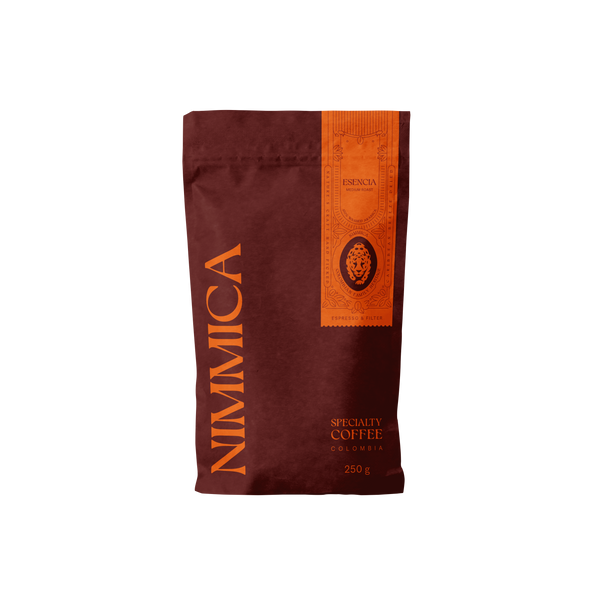
Our Esencia is sourced from family farmers within the Sierra Nevada de Santa Marta — grown through the Ecol Sierra cooperative, where Vivian's family has farmed for generations. Single origin. Roasted in Belgium.

Discover Esencia